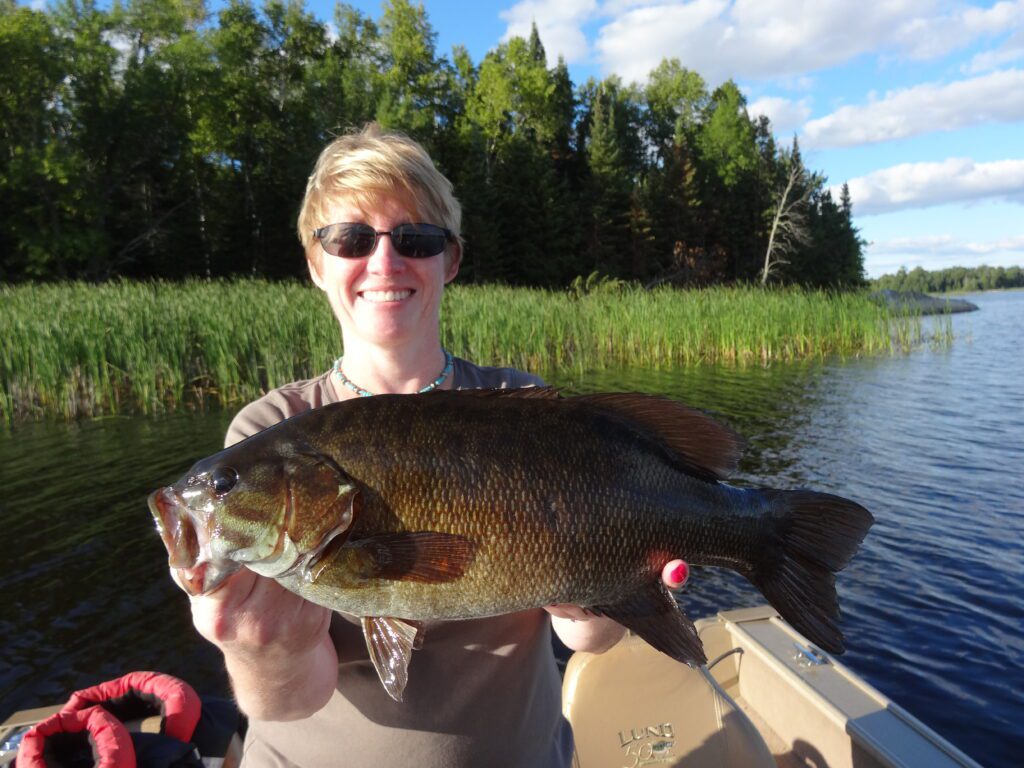
Whether you call them “smallies”, “bronze backs” or some other name, fresh-water small mouth bass are incredibly fun to catch; they are amazing fighters! (The smallmouth bass featured in the photo was caught on Lake Kabetogama with a crawdad colored Rapala Shad Rap fishing lure.)
Warning: This article contains graphic images of fish filleting that some readers may find disturbing.
I don’t remember when I caught my first small mouth bass, and I certainly don’t remember the first one that I ate. I do remember the first one that I attempted to fillet: it was a disaster. I originally tried to fillet a bass using the same method that I had learned to fillet a walleye. Boy was that a mistake! The rib cage bones are very thick – even on the smaller fish – and as tough as nails, literally. There’s a much better way.
Comments from Readers
“I just wanted to take a moment to thank you for your article on cleaning bass. I found your article very helpful in cleaning my first bass. (I have only cleaned catfish before today.)”
“The description and pictures were both great.” (W.M.)“Thanks for your fish cleaning tips!” (S.G.)
“Good exhibits on filleting.” (T & L)
Smallmouth Bass Filleting Instructions
Filleting a smallmouth is very similar to filleting a bluegill with the exception that the bass is usually much larger and often much fatter, although with a bone structure that is much the same.
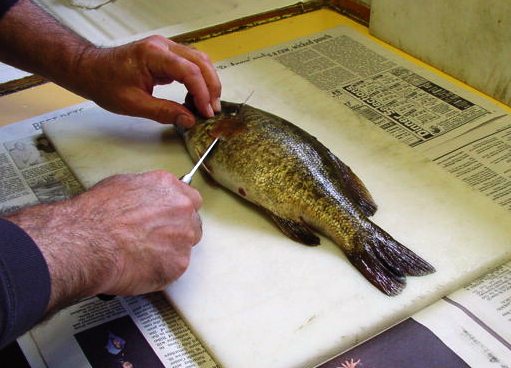
Start by placing the fish belly-side towards you and fish head on your left. Again, note that this description is for a right-handed person – rotate the fish through 180 degrees if you are left-handed. Make the first cut down and into the fish just behind the pectoral fin, stopping at the backbone.
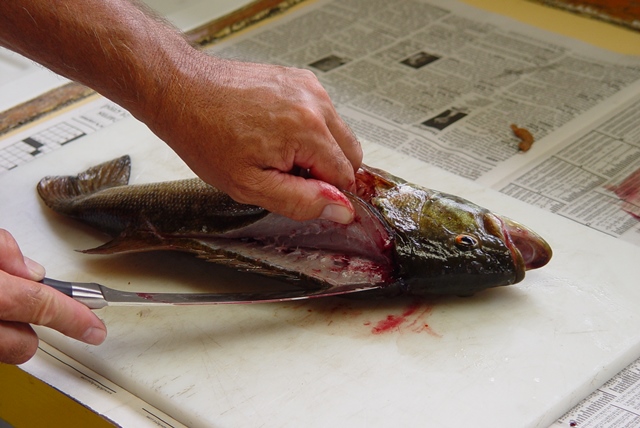
Then, rotate the fish and, starting at the top or backbone side of the fish – and using the tip of the blade – cut through the skin and along the backbone…to a point at approximately the end/back of the dorsal fin.
As with a bluegill, the cut here will not be very deep: you need to cut only to the point at which the ribs attach to the backbone. The rib cage stops at a point just about where the dorsal fin ends.
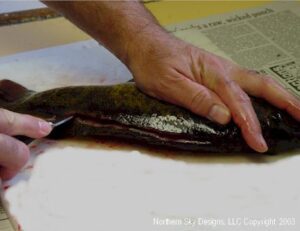
Now insert the knife all the way through the fish so that it emerges on the belly side. Make sure the knife blade stays above the backbone/spine of the fish. Keeping pressure on the flat side of the knife, continue the cut toward the back of the fish, eventually exiting at the tail. At this point, the fillet is attached only at the bottom of the rib cage and the belly.
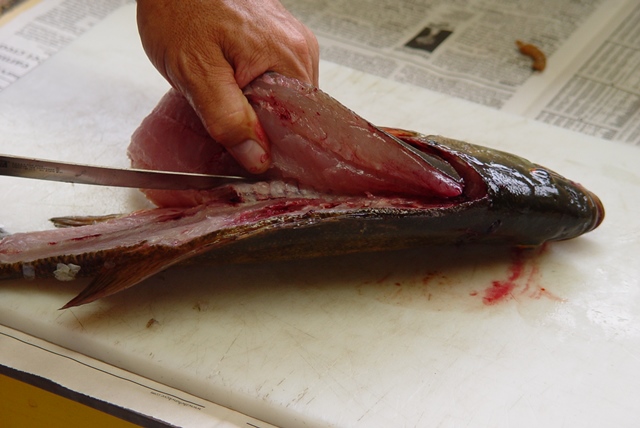
Lift the slab of the fillet and use the tip of the knife to begin to cut the meat away from the ribs. Work from the back of the fish and, following the curve of the rib cage, cut down along the ribs toward the belly and toward the front of the rib cage. The curve of the ribs is very steep and can be difficult to follow. As I have said many times, practice makes perfect, so be patient.
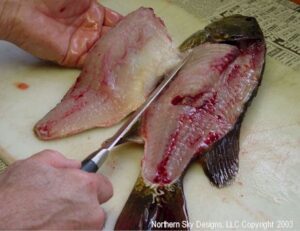
The very last cut to make will be the one through the belly that separates the fillet from the carcass.
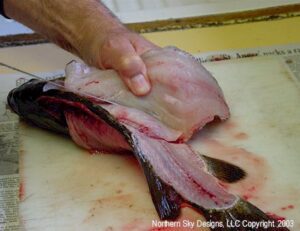
Flip the fish over onto the other side and repeat the process. You will find that one side always seems to be easier than the other. This will be normal until you have filleted many fish… on a fairly regular basis. I find that my first few every year are a little rough – but it all comes back pretty quickly.
The only thing left to do now is to remove the skin from the fillet. Oddly enough, this is the one task that is sometimes made simpler by the use of a “less-than-sharp” knife.
The reason is that a really sharp knife too often cuts right through the skin halfway through the process and makes further removal difficult. I’m not suggesting that you change knives at this point… simply be careful to insure that the blade of the knife doesn’t get angled down too steeply.
At this point, you are mostly finished. Due to the anatomy of the fish, there will still be about 6-8 pieces of rib bones remaining in the fillet that will be a half-inch or so in length. They will extend vertically into the fillet and are located along the lateral line.
I have observed some anglers actually cut out a large V-shaped portion of the fillet to achieve a “totally” boneless fillet. It is effective, to be sure… but it does waste a lot of meat. Another, alternative method, is to remove these several pieces by hand, or grab a small pliers to do the job.
Left in the fillet, they obviously must be removed at the dinner table. In any case, it is surely a small price to pay for one of the better tasting freshwater fish available.

Good luck and good eating. Make sure to check the recipe section of our website for Bass Veronique.