
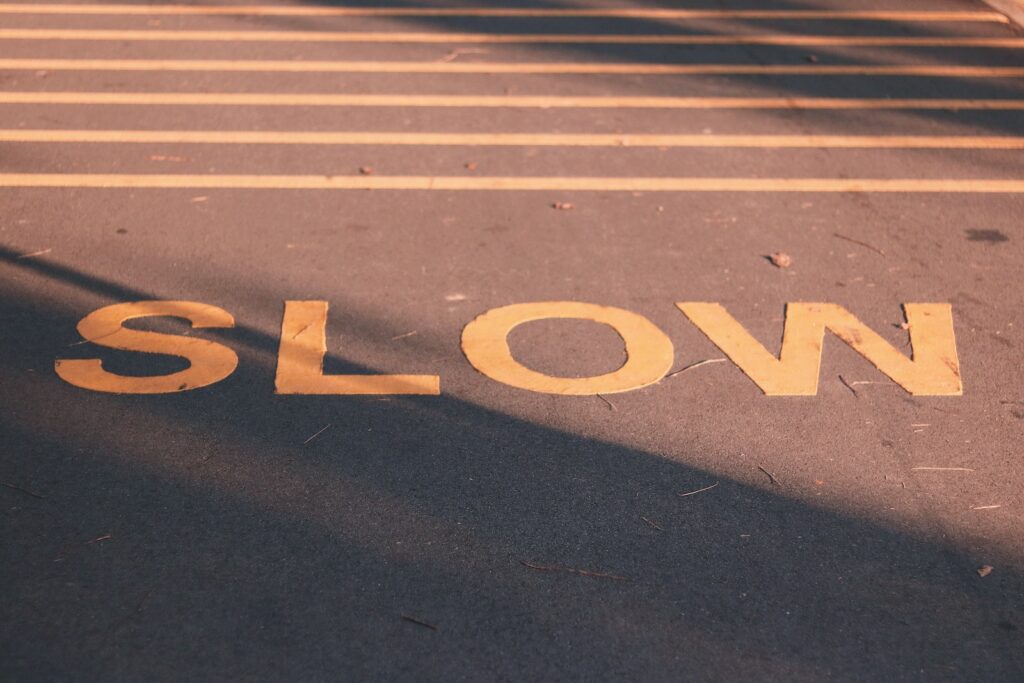
There are five reasons — at least — that should at least allow you to give cause to slow down on your next road trip. The price of gas is now back near the prices we were paying ten years ago, in 2012 and 2013. Does that mean we won’t see lower prices again? No way to tell. However, even though cars continue to show improvements in mpg, I have concentrated ever harder on finding ways to make that gallon of gas go just a bit further. More correctly, the real goal is to make your car go farther on a gallon of gas. I explored that aspect in another article titled “10 Tips to Help Your Fuel Economy”. I have a few more thoughts (and reasons) to add.
(This page may contain affiliate links. You can read our Affiliate Disclosure here.)
. Percents and Fuel Economy
 Let me explain. An increase of 1% in a salary of $100,000 per year (or $1,000) is far greater than a 1% increase in a salary of $50,000 per year (or $500). The same analogy holds true for oil and gas. Fuel economy (in terms of miles per gallon) necessarily becomes far more important as the price per gallon of gas increases.
I won’t bore you with the math, but it’s easy to demonstrate that even small percentage increases in miles per gallon (or mpg) can save you lots of money. This is especially true on longer trips, and especially when pulling a boat or RV. The difference will depend on car model, but can vary by as much as 25% between 55 and 75 mph.
It’s difficult to want to slow down when you’re headed out on that long-awaited vacation, but even five miles per hour slower can make a giant difference in your gas bill; enough of a difference that may allow for an extra night out for dinner on your trip. And a slower speed can certainly add an extra margin of safety for you and your boat – not to mention the other occupants in your car.
To maximize your dollar even further, use GasBuddy.com to find the least expensive price for gas near you.
2. Less Vibration & Road Buzz
 If you have ever driven long distances at expressway speeds, you may have noticed that a typical “road buzz” sets in after you stop for the day. Courses in science would explain that vibrations, especially in an automobile, become significantly amplified at greater and greater speeds – even with newer model cars.
These vibrations have negative effects on both driver and machine. The vibrations will typically shake things lose. If you have ever pulled a boat and trailer to your favorite vacation spot, you should already be well aware of the things that can and do vibrate loose. Always make certain to check and tighten them on a regular basis!
Those same vibrations become more intense at higher speeds. And for anyone who has driven distances in excess of three to four hundred miles at a time, be aware that those vibrations can and do cause both road hypnosis and extreme fatigue. The resulting advice? Slow down, stay awake and be more alert for longer periods of time.
3. Better Reaction Time
A simple fact of driving is generally taught in high school drivers education classes: every mile per hour is approximately equal to 1.5 feet per second. At 60 mph, your vehicle is traveling roughly 90 feet every second. How about stopping your vehicle and trailer at that speed? At this point, the math gets increasingly tricky. The reason is because there are so many factors involved in braking – including reaction time, road conditions and tire conditions to mention just a few.
Add the typical reaction time and your vehicle and its occupants could travel 85-90 feet before your foot even hits the brake pedal. That’s at least five car-lengths in distance. Do you see anyone allowing that zone of safety between cars on today’s roads? At greater speeds, even greater concentration, keener reflexes, sharper skills, and less time to react are all absolutely essential to safe driving. Greater speeds require much greater stopping distances. Need any other reasons to slow down??
4. Cooler Tires Mean Greater Safety Factor
Driving an automobile requires far more skill and concentration than we would probably admit. Add a boat and trailer, or a camper/motor home to the equation, and you can count on dialing things up a notch… or two. Add speed to the mix and trouble is just ahead. I also wrote an article about tires and trailering in which I highlighted some of the problems with tires that are not designed for the speeds at which they are used.
Speed allows for a dangerous enemy of driving to rear its ugly head: Heat. When tires heat up, the pressure inside them increases, thus adding stress to tires that may surely need to be replaced – no matter how they might appear. High speeds cause elevated heat levels. Elevated heat levels cause an increased risk of tire failure. Need I say more?
Excessive heat also causes stress on the hubs of your trailer on which a hefty investment may rest: your boat and your happy vacation. On the way to your favorite vacation spot, have you ever not seen a car and trailer alongside the road (rather than on it) with tire troubles? And if you have ever experienced a blowout while driving, you have got to know how hairy an experience that can be. Slow down and arrive alive!
5. Good Afternoon, Officer (What Speeding Citation?!)
One final reason for traveling to your destination at a reduced rate of speed: preferably the speed limit. You’ll never have to be looking around for those hidden patrol cars behind the viaducts or in the median amongst the trees, just waiting to hand you a coupon for excessive speed. (Stopping you also gives State Troopers yet another reason to check out your boat, trailer, and vehicle for possible violations…). And yep, it is probably true that every citation issued is likely an accident that has been avoided. But if you avoid the citation in the first place, you can do a little extra compensatory spending while on vacation. Perhaps an extra dinner for the family would be a nice surprise!
Getting there Safely
 Fortunate have I been to have traveled to the far reaches of the United States in my lifetime. Were I to add up the miles, I am certain I would be amazed at the total – probably to now be well past the million-mile mark. Many of the round trips have exceeded 6,000 miles and I have made numerous mental notes about the ravages of driving, no matter the length, or time behind the wheel. In my early days, distances and speeds made little difference to me as the price of gas was cheap, far fewer vehicles were on the roads, and my only real concern was simply to get there!
I’m sure that my father would be happy to now hear me say that my youthful excesses and disregard for more intelligent thought have finally given way to a smarter way of approaching life.
Especially when we’re heading out on that long-awaited and well-deserved vacation, getting there in a hurry often takes precedence over precaution. Considering the five reasons above… getting there safely should always top the list!
I hope to see you On the Lake!
R. Karl